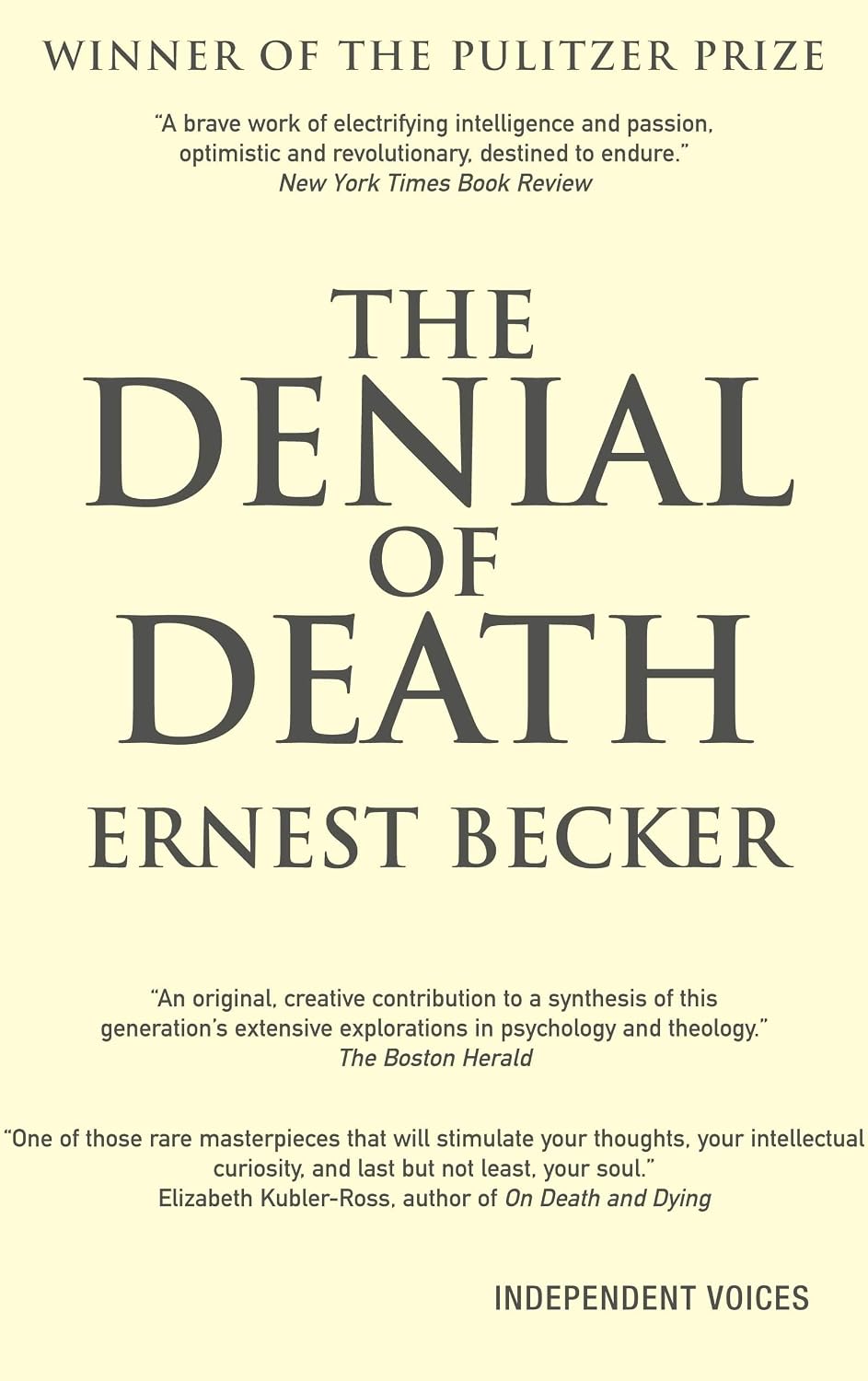
Few books about morality have had the reach of The Denial of Death. Published in 1973, Ernest Becker’s study of how humans manage the knowledge that they will die won the Pulitzer Prize for General Nonfiction in 1974, two months after Becker himself died of cancer at forty-nine. Half a century later, it remains a touchstone for psychologists, philosophers, and anyone who has ever wondered why people cling so fiercely to the things they believe in.
Becker was a cultural anthropologist, but the book ranges far beyond anthropology. It draws on Freud, Kierkegaard, and especially the psychoanalyst Otto Rank to build a single, sweeping argument: that much of human behavior, from personal ambition to religion to war, is shaped by our effort to avoid confronting death.
The Argument at the Center
Becker’s starting point is a paradox. Humans are animals with bodies that bleed, age, and decay, but we are also self-aware creatures capable of imagining infinity. We know we are going to die, and that knowledge is, in his view, too terrifying to hold in full view for very long.
So we build defenses. Becker calls the core of these defenses an “immortality project”: the ways we try to secure significance that will outlast our bodies. For some people, that’s a career, a family legacy, a creative body of work. For others, it’s a nation, a religion, or an ideology. These projects give life meaning, but they also make us defensive, because anyone who challenges our system of meaning seems to threaten our very survival.
From there, Becker examines heroism, love, neurosis, and creativity as variations on the same struggle. The book isn’t a self-help guide or a comforting meditation on mortality. It’s a dense, ambitious work of synthesis that tries to explain why humans behave the way they do.
What Makes It Endure
The central insight is genuinely clarifying. Once you see the pattern Becker describes, it’s hard to unsee it. The intensity of political tribalism, the panic people feel when their beliefs are questioned, the drive to be remembered—all of it starts to look like an elaborate response to a fear most of us never name directly.
The book’s influence also extends well beyond the page. In the 1980s, psychologists Sheldon Solomon, Jeff Greenberg, and Tom Pyszczynski developed Terror Management Theory to test Becker’s ideas experimentally. Hundreds of studies have since found that reminders of death can shift how people judge others, cling to their worldviews, and respond to outsiders. Few works of philosophy have been put to the test this rigorously, and fewer still have held up as well.
Becker’s chapter on Otto Rank is a highlight. His treatment of the artist as someone who wrestles openly with the anxieties others repress offers a hopeful thread in an otherwise heavy book: the suggestion that creativity can be a way of facing reality rather than escaping it.
And there is real intellectual courage in the project. Becker wrote much of the book while seriously ill, and he refuses to soften his conclusions. There’s something bracing about a writer who looks directly at the hardest fact of existence and keeps going.
Where It Shows Its Age
The Denial of Death is not an easy road. The prose is dense, the arguments are layered, and much of the book assumes familiarity with psychoanalytic theory. Readers without a background in Freud or Kierkegaard may find whole chapters slow going.
The book is also very much a product of its time; Becker writes almost exclusively about “man” and his struggles, and women appear mostly as symbols—often as reminders of the body, sexuality, and the animal nature men are trying to transcend. Read through a feminist lens, this framing deserves scrutiny. It positions women as part of the problem the heroic male self is fleeing from, rather than as people engaged in the same existential struggle.
Much of the Freudian framework, especially the material on sexuality and the Oedipal complex, has not aged well either. The core argument survives, but some of the scaffolding around it feels dated.
Finally, Becker offers little in the way of resolution. His closing chapters lean toward a kind of religious or philosophical faith, but they don’t fully answer the question the book raises: if we can’t escape death anxiety, how should we live with it?
Who It’s Written For
The Denial of Death is best for readers who enjoy big ideas and are willing to work for them. If you’re drawn to philosophy, psychology, or cultural criticism, and you like books that reframe how you see the world, it’s well worth the effort.
It’s also valuable for anyone trying to understand polarization, extremism, or why people react so strongly when their sense of meaning is threatened. Becker’s framework offers a compelling explanation for behavior that otherwise seems irrational.
If you’re grieving, facing a serious illness, or in a period of acute anxiety, this may not be the right moment for it. The book is intellectually rigorous rather than emotionally consoling, and it doesn’t pretend otherwise.
Reflections
The Denial of Death is a demanding, imperfect, and genuinely important book. Its language and some of its theory belong to another era, but its central question feels as urgent now as it did in 1973.
Becker doesn’t offer comfort so much as clarity. He invites readers to see how much of human life is organized around a fear we rarely admit, and to consider what might change if we looked at that fear honestly. That invitation alone makes the book worth reading, even where you find yourself arguing with it.
Further Reading on Mortality and Meaning
If The Denial of Death resonates with you, here are some books that explore similar ground:
- The Worm at the Core by Sheldon Solomon, Jeff Greenberg, and Tom Pyszczynski – The researchers behind Terror Management Theory explain Becker’s ideas in accessible language and share decades of experimental evidence.
- Staring at the Sun by Irvin D. Yalom – A psychiatrist’s warmer, more practical approach to death anxiety, drawn from years of clinical work.
- Smoke Gets in Your Eyes by Caitlin Doughty – A mortician’s condid, often funny memoir about death in American culture and why our avoidance of it costs us.
- Being Mortal by Atul Gawande – A surgeon’s reflection on aging, medicine, and what matters most at the end of life.
- Escape from Evil by Ernest Becker – Becker’s posthumously published follow-up, which extends his argument to explain how death anxiety fuels human violence and scapegoating.
Rating: 4/5 Stars
Available wherever books are sold. Check your local independent bookstore first, or find it on Amazon. Link below.





Leave a Reply