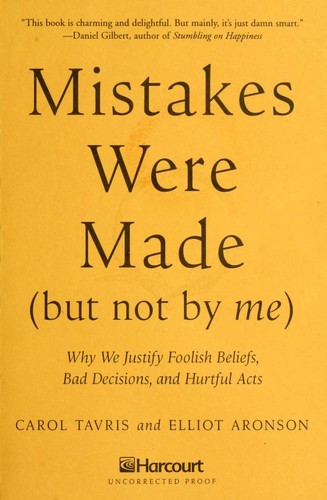
The phrase “mistakes were made” has become a familiar fixture of public apologies, a way for politicians and institutions to acknowledge that something went wrong without naming who was responsible. Social psychologists Carol Tavris and Elliot Aronson borrowed it for the title of their 2007 book, which has since been revised twice, most recently in a 2020 third edition. Their subject is that same evasive instinct, and their argument is that it isn’t limited to politicians. It lives in all of us.
The book’s foundation is cognitive dissonance theory, first developed by psychologist Leon Festinger in the 1950s and expanded by Aronson over a long research career. Tavris, the author of The Mismeasure of Woman, brings a sharp, accessible writing style. Together they set out to explain why it is so difficult for people to say “I was wrong” and genuinely mean it.
The Idea Behind the Book
Cognitive dissonance is the discomfort we feel when we hold two conflicting ideas at once, especially when one of them is “I am a good, smart, reasonable person” and the other is evidence that we did something foolish or harmful. Tavris and Aronson argue that the mind resolves this tension not by admitting the mistakes, but by rewriting the story so the mistake disappears.
One of the book’s most useful images is a pyramid. Two people start at the top with nearly identical views. One makes a small choice in one direction, the other in the opposite direction, and each then justifies that choice. Over time, those justifications pile up, and the two people slide down opposite sides of the pyramid until they end up at the bottom, convinced the other is foolish or even immoral.
The authors apply this framework across a wide range of settings: marriages, family estrangements, medicine, therapy, the criminal justice system, and international conflict. In each case, they show how ordinary self-justification can harden into something far more damaging.
Why It Lands
The book’s greatest strength is its universality. Tavris and Aronson aren’t writing about villains. They are writing about decent people who make one bad choice and then defend it so thoroughly that they can no longer see it clearly. That framing makes the book feel less like an accusation and more like a mirror.
The chapter on the criminal justice system is especially powerful. The authors examine how police, prosecutors, and judges can become so invested in a conviction that they resist evidence of innocence, even when DNA results point elsewhere. It’s a sobering look at how institutional self-justification can cost people years of their lives.
The material on relationships is equally striking. Tavris and Aronson describe how couples slide into blame, each partner building a story in which they are the reasonable one. Their account of how small resentments harden into contempt will feel uncomfortably familiar to anyone who has watched a relationship unravel.
The prose is clear, often witty, and grounded in decades of research. It’s a book about psychology that reads like an extended conversation rather than a textbook.
Where to Read Critically
The chapter on memory and theory deserves careful reading. Tavris and Aronson critique the recovered-memory movement of the 1980s and 1990s, when some therapists used suggestive techniques that led clients to “remember” abuse that later proved not to have happened. Their account of those cases, and of the professionals who refused to reconsider their methods, is well documented.
Still, survivors of real abuse may find this section difficult. The authors are careful to distinguish between false memories and genuine trauma, but the chapter’s emphasis on memory’s unreliability could feel dismissive to readers whose experiences have already been doubted. It’s worth reading alongside trauma-informed work that takes survivors’ memories seriously while acknowledging the science.
The book can also feel repetitive. Once you understand the core mechanism, many of the later chapters apply it to new settings without adding much new insight. And while the authors devote their final chapter to how we might live with dissonance more honestly, the practical guidance is thinner than the diagnosis.
Who Will Get the Most From It
Mistakes Were Made (But Not by Me) is ideal for readers who are curious about human behavior and willing to turn that curiosity inward. It’s especially useful for people navigating conflict, whether in a marriage, a family, a workplace, or a community, and trying to understand why the other side seems so unwilling to budge.
It’s also valuable for anyone interested in justice, medicine, or public life, since it explains how institutions resist correction even when the evidence is clear.
If you’re looking for a step-by-step guide to changing your behavior, this book offers more understanding than instruction. But understanding is often where change begins.
Last Word
Tavris and Aronson have written a book that is both illuminating and humbling. It explains a great deal about the world, from political stalemates to family estrangements, while gently insisting that the reader is not exempt.
The book’s real gift is permission. It suggests that being wrong is not a moral failure but a human inevitability, and that the willingness to admit it is a strength. In a culture that often treats changing your mind as weakness, that message feels quietly radical.
Keep Reading
If Mistakes Were Made (But Not by Me) resonates with you, here are some other suggestions:
- Being Wrong by Kathryn Schulz – A thoughtful, beautifully written exploration of error and why we find it so hard to accept. Schulz pairs well with Tavris and Aronson’s research
- Think Again by Adam Grant – An organizational psychologist makes the case for rethinking and unlearning, with practical strategies for staying open to new evidence.
- The Mismeasure of Woman by Carol Tavris – Tavris’s earlier book examines how biased research has shaped what we believe about women, an ideal follow-up for readers interested in a feminist lens on psychology.
- The Righteous Mind by Jonathan Haidt – An exploration of why moral and political disagreements feel so intractable, and how intuition drives our reasoning.
- The Body Keeps the Score by Bessel van der Kolk – For readers who want a trauma-informed counterweight to the book’s chapter on memory, van der Kolk explains how traumatic experiences are stored and recalled.
Rating: 4/5 Stars
Available wherever books are sold. Check your local independent bookstore first, or find it on Amazon. Link below.






Leave a Reply