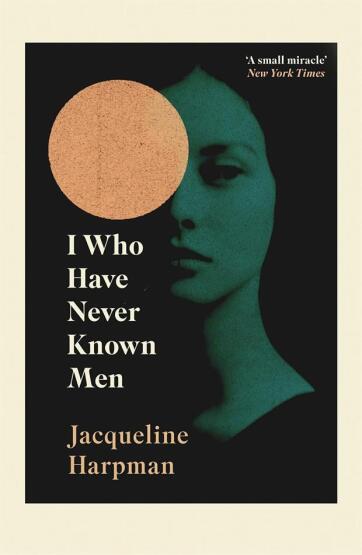
First published in French in 1995, I Who Have Never Known Men spent decades as a quiet cult novel before a new English edition from Transit Books in 2022 turned it into an unlikely bestseller, carried largely by readers urging one another to pick it up. Jacqueline Harpman, a Belgian writer and psychoanalyst who fled to Casablanca with her family during World War II, wrote a book that is short, spare, and almost impossible to summarize without making it sound bleaker than it feels.
The premise is simple and unsettling. Forty women live in an underground cage, watched by silent male guards, with no memory of how they got there and no way to measure time. Thirty-nine of them remember fragments of an earlier life. The fortieth, the novel’s narrator, was a child when she arrived and remembers nothing else at all.
Inside the Cage
I Who Have Never Known Men is often shelved as dystopian or post-apocalyptic fiction, but it reads more like a philosophical fable. When an alarm sounds and the guards abruptly abandon their posts, the women climb out into a barren, empty landscape and begin walking. What follows isn’t a thriller or a mystery to be solved. It’s an extended meditation on how a person builds a self and a life when every explanation has been withheld.
The narrator is the heart of the book. Unlike the older women, she has no memories of family, love, or ordinary society to grieve. She doesn’t know what she’s lost, only that something is missing. Her education, pieced together from the other women’s stories and her own fierce curiosity, becomes the real plot.
It’s less “what happened to the world” and more “what does it mean to be human when the world won’t tell you anything.”
Where the Novel Shines
Harpman’s prose, in Ros Schwartz’s translation, is plain and controlled in a way that makes the strangeness hit harder. There are no dramatic set pieces or lush descriptions. Instead, the book accumulates small, precise observations: the narrator learning to track time by counting her own heartbeat, the women’s arguments over whether hope is worth the effort, the tenderness that grows between people who have nothing to offer each other but company.
Read through a feminist lens, the novel is quietly devastating. These women have been confined, observed, and kept ignorant by men who never speak to them. Their bodies are policed, their knowledge is rationed, and their freedom, when it comes, arrives without context or instructions. Harpman never states any of this as a thesis, which is exactly why it lingers. The cage is never explained, and the absence of explanation becomes the point.
The book is also deeply concerned with female friendships and care. The women argue, pull apart, and come back together. They tend to one another through illness and fear. In a world stripped of every structure, it’s the relationships between them that give life any shape at all.
Harpman’s background in psychoanalysis shows in how closely she attends to longing—especially the narrator’s hunger for touch, intimacy, and understanding in a life that has denied her all three. The title carries real weight by the final pages.
Where It Asks More of the Reader
This is not a book for readers who need answers. Who built the cage, why the women were imprisoned, what happened to everyone else—none of it is ever resolved. For some readers, that refusal is the novel’s genius. For others, it will feel like a puzzle with the pieces deliberately removed.
The pacing can also feel slow and repetitive in the middle stretch, when the women are walking through an unchanging landscape. That monotony is intentional, a mirror of the narrator’s experience, but it asks for patience.
And while the book is short, it is emotionally heavy. It deals with isolation, grief, illness, and death with an unflinching steadiness. It isn’t graphic, but it is sad in a way that sits in your chest for a while after you finish.
Who Should Pick It Up
I Who Have Never Known Men is best suited for readers who love literary fiction that leaves room for interpretation—people who enjoy finishing a book and immediately wanting to talk about it. It’s a natural fit for book clubs, and for anyone drawn to feminist dystopias that work through atmosphere and implication rather than spectacle.
It will resonate especially with readers interested in questions of memory, identity, and how meaning gets made in isolation. If you’ve ever had to rebuild a sense of self without a map, the narrator’s slow, stubborn self-education may feel uncomfortably familiar.
If you’re looking for world-building, a clear villain, or a satisfying reveal, this isn’t your book.
Final Thoughts
I Who Have Never Known Men is a small novel with an enormous interior. Harpman takes away almost everything we rely on to make sense of a life—history, explanation, community, love—and then asks what’s left. Her answer is neither hopeless nor consoling. It’s simply honest.
The book succeeds because it trusts its readers to sit with uncertainty. It doesn’t tell you what the cage means. It lets you carry the question with you, which may be the most faithful way to write about women whose lives were shaped by forces they were never allowed to name.
What to Read Next
If I Who Have Never Known Men resonates with you, here are some other books that explore similar themes:
- The Wall by Marlen Haushofer – An Austrian classic about a woman suddenly cut off from the rest of the world by an invisible barrier. Like Harpman’s novel, it’s a quiet, interior story of survival and solitude.
- The Handmaid’s Tale by Margaret Atwood – The defining feminist dystopia, exploring control over women’s bodies and knowledge in a far more explicit political frame.
- Never Let Me Go by Kazuo Ishiguro – Another novel narrated by someone who doesn’t fully understand the system she was raised inside, with the same restrained, slowly devastating tone.
- The Water Cure by Sophie Mackintosh – A strange, lyrical novel about sisters raised in isolation and taught to fear men. Mackintosh wrote the afterword for the Transit edition of Harpman’s book.
- Herland by Charlotte Perkins Gilman – A century-old feminist utopia that makes a fascinating counterpoint: a world without men imagined as liberation rather than abandonment.
Rating: 4.5/5 Stars
Available wherever books are sold. Check your local independent bookstore first, or find it on Amazon below.







Leave a Reply