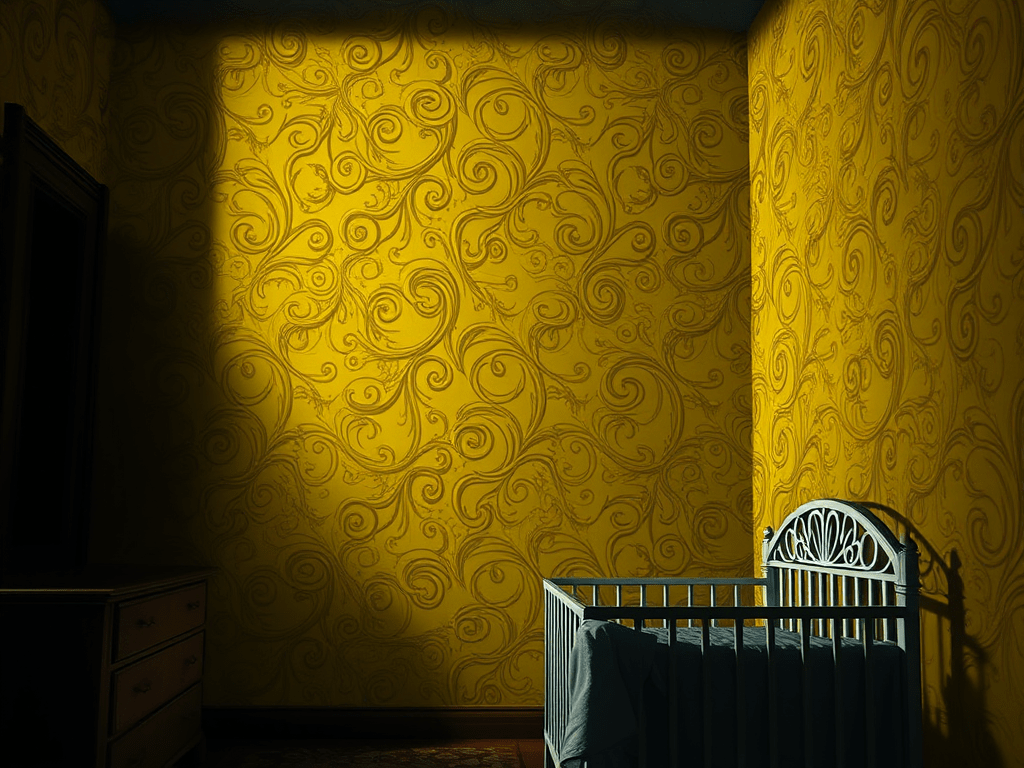
“The color is repellent, almost revolting; a smouldering unclean yellow…” — Charlotte Perkins Gilman, “The Yellow Wallpaper“
When I first read The Yellow Wallpaper, I was struck by how claustrophobic it felt. A woman slowly unraveling in a nursery-turned-prison, haunted by a pattern on the wall. At the time, I thought it was eerie, strange, maybe a little exaggerated. But now, after examining it and breaking it down, I see it differently. It’s not just about madness. It’s about the way women are silenced, dismissed, and slowly peeled away from themselves.
Over 130 years since its publication, Charlotte Perkins Gilman’s short story is still deeply unsettling—and deeply relevant.
The Story We Keep Coming Back To
The Yellow Wallpaper was published in 1892. It follows a woman whose physician husband confines her to a room in a rented mansion for the summer, prescribing her the infamous “rest cure” to treat her postpartum depression. She’s forbidden from writing, seeing friends, or engaging with anything that stimulates her mind. Slowly, she begins to obsess over the yellow wallpaper in her room, convinced there is a woman trapped behind it. By the end, she identifies with the woman in the wall and tears the paper from the walls in a frenzy, declaring that she has finally escaped.
Gilman herself suffered a similar fate. After enduring the “rest cure” at the hands of Dr. S. Weir Mitchell, she wrote the story as a warning. It was, as she once said, “not intended to drive people crazy, but to save people from being driven crazy.”
Still Fighting to Be Believed
What makes The Yellow Wallpaper relevant is how clearly it describes something that’s still happening today: women not being believed about their own bodies and minds.
In the 19th century, women were routinely diagnosed with “hysteria” and subjected to the infamous “rest cures” that stripped them of autonomy. Today, the language is more clinical, but the outcomes can feel hauntingly familiar. Studies continue to show that women’s pain is more likely to be dismissed, their symptoms misdiagnosed, especially women of color. Many women with chronic illness or neurodivergence spend years trying to find answers, only to be told it’s “just anxiety.”
The narrator’s descent into obsession isn’t a failure of her mind—it’s a reaction to being silenced and trapped. She’s not mad. She’s unseen.
The Wallpaper: Then and now
The yellow wallpaper is grotesque, shapeless, and impossible to understand, just like the rules that govern the narrator’s life. Her fixation on the wallpaper grows as her isolation deepens, until she starts to see a woman creeping behind the pattern. That woman becomes her mirror.
In 2025, many of us still see ourselves in this metaphor. The woman behind the wallpaper represents the self that’s been hidden, repressed, or contorted to fit into a role. Whether you’re a mother navigating postpartum depression, a creative struggling with burnout, or someone questioning the systems you’ve been told to trust—the paper still peels.
The wallpaper is patriarchy. It’s capitalism. It’s the pressure to be fine when you’re not fine.
A Cornerstone of Feminist Literature
Gilman’s story is now a staple of feminist literature, taught in classrooms and discussed in reading circles around the world. It opened the door for other literary works that grapple with madness, motherhood, and resistance—from Kate Chopin’s The Awakening to Sylvia Plath’s The Bell Jar, and even modern memoirs like Carmen Maria Machado’s In the Dream House.
It’s more than a story, The Yellow Wallpaper is a political artifact. It helped launch feminist literary criticism and continues to be cited in discussions of embodiment, domesticity, and gendered mental health.
Even now, it raises questions that matter: Who gets to define what is sane? What happens when we silence women’s voices? What does healing look like when control is taken away?
Why It Still Haunts Us
Postpartum depression is finally being talked about more openly, but stigma lingers. Social media may offer communities, but it also amplifies pressure to perform perfectly. The loneliness of new motherhood, or the womanhood in general, hasn’t gone away.
The narrator’s isolation feels eerily familiar: confined to a room, dismissed by her partner, forced to deny her own instincts. Her act of tearing the wallpaper becomes an act of rebellion, but also a cry for help. We read it today and still ask: was she liberated, or did she break?
The truth might be both.
My Own Wall
I first read The Yellow Wallpaper in college. I admired its craft, its slow burn. But it didn’t gut me the way it does now.
After the chaotic start in my adult life, working high-pressure jobs, battling anxiety, and trying to meet everyone’s expectations, I saw the wallpaper starting to move. Not literally—but in a sense that I knew what it felt like to lose pieces of yourself, little by little, for the sake of appearing “well.”
Writing became my way out long ago. Just as the narrator secretly wrote in her journal, I scribbled in notebooks, started writing relatable short stories, then created my blog. It’s how I found myself again—how I continue to find myself everyday.
We Still Need This Story
In a world that still struggles to hear women, The Yellow Wallpaper remains an important read. It reminds us that madness can be a message. That silence is not always safety. That sometimes, the bravest thing a woman can do is tear down the walls built to contain her.
“I’ve got out at last,” she says. “in spite of you and Jane. And I’ve pulled off most of the paper, so you can’t put me back!”
We’re still talking about this story because we’re still living it. But we’re also rewriting it—one peeled layer at a time.
If you haven’t read The Yellow Wallpaper yet, you can find it here for free. It’s short, but unforgettable.





 Kat McAdaragh
Leave a comment