Book Review: The Underground Library
In times of crisis, what matters most? Jennifer Ryan’s The Underground Library suggests that sometimes the answer is as simple and as radical as ensuring people have access to stories. Set during the London Blitz, this novel transforms the familiar narrative of wartime heroism into something more intimate and revolutionary: the quiet courage of librarians determined to keep literature alive in the darkest of times.
The story follows Juliet Lansdown, a young librarian who refuses to let the Bethnal Green Library close despite the constant threat of German bombings. Instead, she moves operations underground into the tube station where Londoners shelter nightly from air raids. What begins as a particular solution—bringing books to people who desperately need escape—evolves into something far more profound: a testament to the power of literature to sustain the human spirit when everything else has crumbled.
Ryan, author of The Chilbury Ladies’ Choir, demonstrates once again her gift for finding extraordinary stories in ordinary circumstances. Her research into the actual underground libraries that operated during the Blitz lends authenticity to every page, from the makeshift shelving systems to the careful rationing of precious books. The historical details never feel heavy-handed; instead, they create a vivid backdrop that makes the characters’ struggles feel immediate and real.
What elevates The Underground Library beyond typical wartime fiction is its focus on the democratization of literature. Ryan explores how the bombing of London inadvertently broke down class barriers, forcing people from different backgrounds to shelter together underground. Juliet’s library becomes a great equalizer—a place where a charwoman and a society lady might bond over the same romance novel, where children from bombed-out homes can lose themselves in fairy tales.
The novel’s greatest strength lies in its cast of characters, each dealing with loss and fear in their own way. There’s Katie, a young mother struggling to protect her daughter while grieving her boyfriend’s death. Sofie, a German refugee, whose love of books helps her find acceptance in a community suspicious of foreigners. Ryan gives each character distinct voices and compelling arcs that weave together beautifully.
The romance subplot between Juliet and Sebastian feels somewhat predictable, and occasionally the dialogue veers toward the overly sentimental. But these are minor issues when the novel succeeds brilliantly at its larger mission: celebrating the vital role literature plays in human resilience.
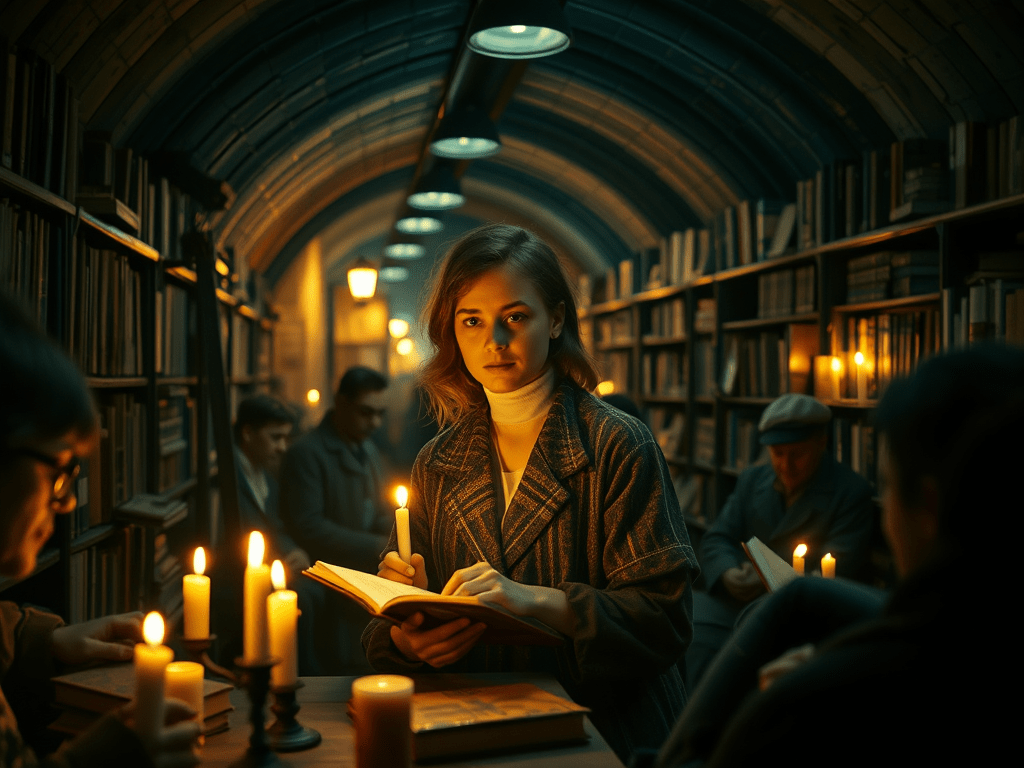
Ryan’s prose is warm and accessible, creating an atmosphere that feels both cozy and urgent. She has a particular gift for capturing the way books can serve as bridges between people, how a shared story can create instant connections between strangers. Her descriptions of the underground library itself—candles flickering over makeshift shelves, the sound of pages turning amid the distant rumble of bombs—are exquisite.

The novel also serves as a reminder of libraries’ essential role in communities. In our digital age, when physical libraries face budge cuts and declining usage, Ryan’s portrayal of books as literal lifelines is relevant. The underground library becomes a symbol of hope, proof that culture and learning can survive even the most determined attempts to destroy them.
The Underground Library won’t surprise readers familiar with historical fiction’s conventions, but it will satisfy them. It’s a book that celebrates books, a story that reminds us why stories matter. In Ryan’s hands, the simple act of lending a novel becomes an act of defiance, proof that even in humanity’s darkest hours, the need for beauty and connection endures.
This is comfort reading in the best sense—not because it avoids difficult topics, but because it affirms our capacity to find light in darkness. For anyone who has ever found solace in a library or discovered friendship through a shared love of reading, The Underground Library will fill like coming home
Rating: ★★★★☆





 Kat McAdaragh
Leave a comment